


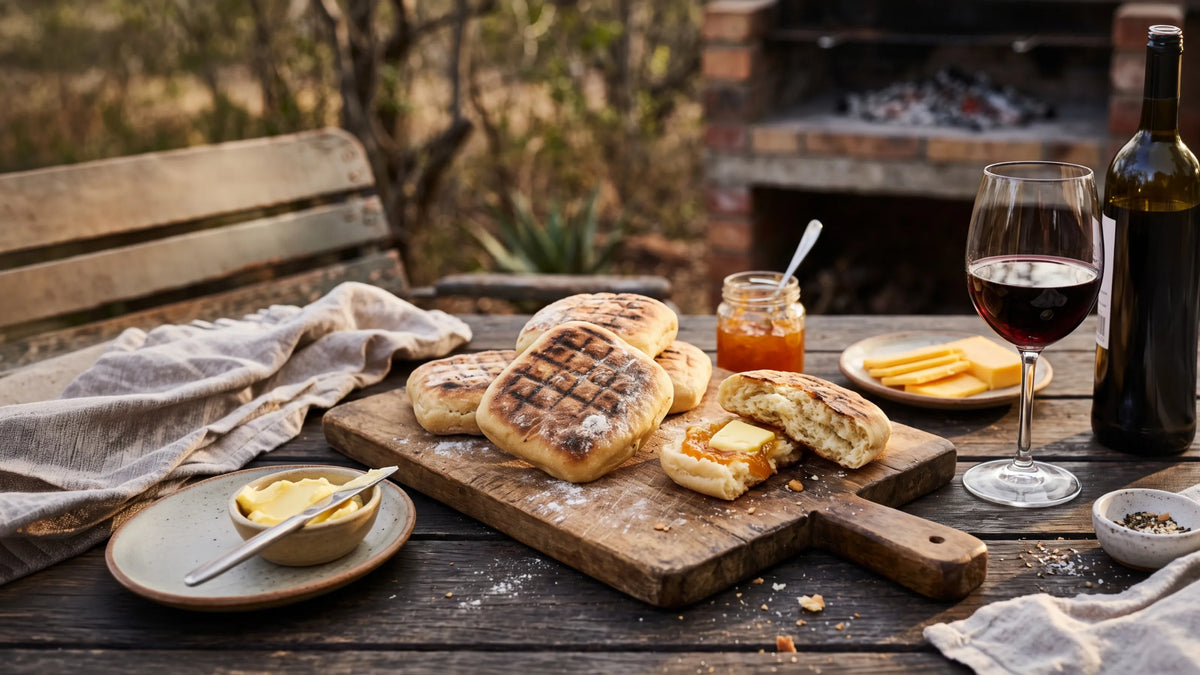
The roosterkoek comes off the coals at Akkerboom with ash still on its shoulders. Torn open, it steams once in the cool air and then stops. It is not yet eight, and the farm stall between Keimoes and Kakamas still holds the night's chill under its trees, but the light on the vineyards beyond the fence has already turned from grey to brass.
On the counter, dates sit in punnets, dark and glossy. Beside them are dried apricots sharp enough to make the jaw ache, and paper bags of sultanas the colour of weak tea held up to a window. Someone is cutting milk tart. By ten the heat will be in charge, and anything meant to be eaten in the cool has to be eaten now.
This is the Green Kalahari, the irrigated ribbon of the Orange River between Upington and Augrabies, and it rewards people who travel to eat and drink. It is not a winelands of gabled estates. Its pleasures are plainer and more particular: fruit dried by the sun, lamb that tastes of what it grazed, sweet wines from old Muscat vines, and brandy distilled twice through copper. The way to taste it is to follow the day, because here the heat decides what is eaten when.
Rain barely figures. Upington averages around 36°C by day in January, and the vineyards live on the river alone, its water led out to the farms through canals that have run for more than a century. That water makes the Northern Cape home to about a tenth of South Africa's vines, though most of the fruit never becomes wine. Roughly nine in ten of the country's raisins come from these Orange River farms, and most of them are exported.
The wine came later, and brandy came with it. In the 1960s, KWV looked to the river for Chenin Blanc and Colombar to distil, and the Orange River co-operative cellar, founded in 1965, grew into one of the largest wineries in the world. The furnace-hot summers and cold winter nights that make the farming hard also keep pests away, which is why organic growing works here better than you might expect. Everything that reaches the table carries that climate: concentrated, sun-sweet, and plainly made.
Morning
Moerkoffie, Roosterkoek and the Last of the Cool
In the farmhouses along the river, the day still starts with moerkoffie: coarse grounds boiled in the pot and left to settle, poured black before anyone goes out to the vines. The padstalle keep the same hours as the farms. Akkerboom sits on a working grape farm at Friersdale, and by the time the bakkies pass on their way to the rows, it is serving farmhouse breakfasts, roosterkoek, its well-known milk tart and ginger beer, with free-range meat in the fridge and young quiver trees for sale by the gate.
The roosterkoek is the thing to order. It is bread dough baked directly over coals, so the crust takes on smoke and blisters while the middle stays soft and slightly chewy. Eaten with butter and apricot jam, it is the most honest breakfast on the river.
Pies by the Bridge
Further west, by the bridge outside Kakamas, Die Pienk Padstal has been a stopping point on the N14 for long enough that its colour has become a landmark. Inside are the valley's crops in season—dates, raisins, fresh grapes—alongside coffee, breakfasts, and light meals from the diner. The pies are what people stop for, and they do not last the day. Arrive before mid-morning, or settle for whatever is left.
On the south bank, the R359 runs back towards Upington through Kanoneiland, and Kanoniki Farm Stall offers a quieter version of the same morning: home baking, locally made goods, dried fruit by the bag, and light meals on an island that is almost entirely vineyard.
Dates and pecans are worth buying at every stall. Both grow on the river farms, and both are at their best eaten close to where they were picked. A Medjool date from here is soft enough to split with a thumbnail, with the texture of fudge and a faint caramel bitterness near the stone.
Midday
The Amber Fruit
The sultana is the valley's real signature, and it is made slowly. Between January and March, sultana grapes are cut and laid out on the droogbane, the drying beds. In this valley, the racks are shaded so the renowned golden raisins never takes the full sun, which slows the drying and gives the region's sultanas their golden yellow colour rather than the near-black of fruit dried in the open.
The difference is easy to taste. A shade-dried sultana keeps a thin, almost translucent skin and a flesh that is chewy rather than leathery, sweet first and then faintly sharp, like honey with a squeeze of lemon. Most of the crop is shipped abroad in bulk, so the padstalle are where to find it at its best: by the bag at Die Pienk Padstal and Kanoniki, or alongside the dates at Akkerboom. A handful eaten on the road is a better introduction to the valley than any brochure.
Lamb That Tastes of Where It Grazed
The Northern Cape eats meat the way the Cape Peninsula eats fish, and the counter at the Kalahari Vleishuis in Keimoes shows why. The butchery sells free-range lamb from the Kalahari and from Boesmanland, processes game for hunters, and cures biltong that has earned its own following.
Patrys van Niekerk, the second-generation butcher who built its reputation, is also the source of one of the region's small legends. A local pharmacist named Flip once asked her to debone a lamb rib and rub it with a particular mix of herbs and spices. His friends tasted it, then asked for it themselves, and “Flip se Rib” became a fixture of braais up and down the river.
People here also take lamb terroir seriously. Lamb from around Kenhardt grazes on the aromatic shrubs of the Northern Cape, while Kalahari lamb walks the dunes for wild grass, and regulars claim they can tell the two apart from the smell on the braai alone. If you are self-catering, buy one of each and decide for yourself.
Regulars claim they can tell where a lamb grazed from the smell of it on the braai.

A Long Lunch in the Shade
By one o'clock, shade is worth more than any view, and lunch here is built around it. At Bezalel Wine & Brandy Estate, on the N14 between Upington and Keimoes, the Farm Kitchen sets its tables under the trees and cooks from the farm and its neighbours. The menu runs from Kalahari lamb pies and a family-recipe bobotie, gently spiced and set under its savoury custard, to burgers served on roosterkoek baked in the wood-fired oven, and salads made from whatever was picked that morning. It is the kind of lunch that turns into the afternoon without anyone deciding it should.
Afternoon
Tasting the River
The heat peaks in the afternoon, and the valley's cellars are the place to wait it out. They also show how much a single river can produce.
In Upington, the Orange River Cellars Tasting Room on Schröder Street pours from the co-operative that started it all. A tasting covers five glasses of your choice, and the pairings take a playful approach to local sweetness: sparkling wine with Turkish delight, brandy with chocolate, gin with dried fruit, and something sweet with nougat. Die Kerkmuis, the restaurant on site, sends out platters to go with them.
Start with the Colombar, which grows here more widely than almost anywhere else in South Africa. It is crisp and lightly tropical, with a guava note that seems right for the climate. Then move on to the sweet wines the valley does best. The co-operative's Red Muscadel is award-winning and deep with raisins. Its straw wine is made from grapes left to dry after picking, so the sugar concentrates before fermentation begins and the wine pours like liquid apricot.
Kakamas and beyond
Downstream at Kakamas, Die Mas, founded by two schoolteachers, Vlok and Welna Hanekom, offers its own cellar and still, a campsite on the riverbank, and Deck & Vine, a restaurant set among the vineyards.
The farm's Goue Hanepoot is the glass to try. It is made from Muscat of Alexandria, the old grape the Cape has always called Hanepoot, and it smells of pineapple and orange peel before finishing on honey. The Rooi Muskadel is deeper, tasting of raisins with a hint of beeswax. Die Mas's potstill brandy is called Die Kalahari Truffel, named after the desert's rarest food. The !naba, or Kalahari truffle, which grows only in red sand beside a particular low shrub, and only after the right rains. Foragers find it by the hairline cracks it leaves in the soil and lift it out by hand. At the right time of the year you might be able to buy some next to the road.
Twice Through Copper
Back on the N14, Bezalel's Tasting Room sits inside a cellar built from granite removed from the flood plain to make room for vines—stone about 1.1 billion years old and roughly a metre thick, which keeps the room cool however hot the afternoon gets. Its oldest stills, the twins, a matched pair of 680-litre copper pots with hand-hammered onion heads sharing one condenser, still handle much of the work. Every batch goes through copper twice, and the cut between heads, heart, and tails is made by nose rather than by sensor.
The VSOP then spends six to eight years in 300-litre French oak, the XO over a decade and the XXO two decades. The Rooibos Brandy goes further: after five years in French oak, it is matured on rooibos wood, a first in South Africa. It pours a deep amber with a red edge and smells of burnt caramel, orange peel, and the red bush itself. It makes the strongest case of the afternoon that this river can produce something found nowhere else.
Dusk
The Stoep at Last Light
Evening comes quickly in the desert, and it is worth being somewhere still when it does. At Bezalel, the stoep of the restored 1930s farmhouse looks out over the vineyards, the farm's irrigation dam, and the lower Orange River valley.
Watch the east as the sun goes down. A band of blue-grey rises above the horizon, which is the shadow of the earth itself, edged with a thin arch of pink. The dam turns pewter. The irrigation pumps cut out one by one, and the weavers in the reeds fall silent. In the quiet that follows, you can hear water moving in the canals.
A brandy belongs here, poured neat and cellar-cool. In the glass, dried apricot sits under the oak, and orange peel follows on the breath.
The cold arrives fast. Even after a warm spring day you will want a jacket within the hour; in July, nights fall to around four degrees. Then the first star appears over the koppies.
Somewhere in the car there is still a paper bag from the morning, its sultanas warm now and slightly tacky from the dashboard. Eat one in the dark and the shape of the day becomes clear. The same river sugar has turned up in every form: fresh on the vine at breakfast, slowly dried in the shade, concentrated in a Muscat, and finally distilled twice through copper and laid down in oak. The valley does not have many ingredients. It has the sun, the river, and the patience to wait for both.
Local Highlights
Farm Stalls and Padkos
- Akkerboom Farm Stall, Friersdale (between Keimoes and Kakamas): Farmhouse breakfast, roosterkoek, milk tart, ginger beer, dried fruit, and free-range meat.
- Die Pienk Padstal, Kakamas: By the bridge on the N14. Dates, raisins, and grapes in season, plus pies (go early).
- Kanoniki Farm Stall, Kanoneiland: On the R359, with home baking, dried fruit, light meals, wine, and spirits.
- Oma Miemie's, Kenhardt (further afield): Karoo lamb pie in all-butter pastry, pecan pie, and shelves of local jams, rusks, and chutneys.
Cellars and Tastings
- Orange River Cellars Tasting Room, Upington: Colombar, Red Muscadel, and straw wine; pairings with Turkish delight, chocolate, dried fruit, and nougat; Die Kerkmuis restaurant on site.
- Die Mas van Kakamas: Goue Hanepoot, Rooi Muskadel, Die Kalahari Truffel potstill and gin, with lunch at Deck & Vine.
- Bezalel Wine & Brandy Estate (N14 between Upington and Keimoes): Copper-potstill brandies by the glass, including the VSOP and the Rooibos Brandy, a guided brandy-and-chocolate pairing, and lunch at the Farm Kitchen under the trees.
For the Cooler Box
- Kalahari Vleishuis, Keimoes: Free-range Kalahari and Boesmanland lamb, game, biltong, and Flip se Rib.
- Sultanas, dates, and pecans: From whichever padstal you pass first.
Plan Your Visit
The Route
- Upington Airport sits just outside town.
- Along the N14 heading west, Kanoneiland is about 25 km away, Keimoes about 40 km, Kakamas about 90 km, and Augrabies Falls National Park roughly 120 km.
- Akkerboom lies off the N14 between Keimoes and Kakamas, at Friersdale.
- Kanoniki is on the R359, the south-bank road that makes a slower return to Upington.
- Oma Miemie's is in Kenhardt, south of Keimoes on the R27.
- The whole route is drivable in an ordinary sedan.
Where to Refuel
- The padstalle open early, and the best of their baking sells out by midday.
- The Orange River Cellars Tasting Room is closed on Sundays.
- Die Mas pours Monday to Saturday.
- Bezalel's Farm Kitchen and Tasting Room are open seven days, with the kitchen serving its full menu through the day (check specific hours online before visiting).
- For groups of eight or more, book ahead anywhere you plan to eat or taste.
Where to Base Yourself
- Die Mas, Kakamas: Self-catering chalets or riverbank camping.
- African Vineyard, Kanoneiland: A registered Slow Food establishment with food-and-wine pairings.
- De Akker Cottages, Friersdale: Self-catering, on the Akkerboom farm.
- Ou Skool Guesthouse: Located just outside Keimoes.
-
SANParks: Chalets inside Augrabies Falls National Park.
- Bezalel Estate Country House: A restored 1930s farmhouse sleeping eight, or Garden Rooms beside the Tasting Room (with a tasting included in every stay). See the farmstay.
Staying at Bezalel
When to Go
- April–May and August–October: Bring warm days and cool evenings, which suit long lunches.
- January to March (Drying Season): Averages 36°C by day. Hot, but busy and fragrant.
- July: Nights fall to around 4°C and sometimes below freezing.
What to Pack
- A wide-brimmed hat and high-SPF sunscreen.
- More water than you think you need.
- A warm layer for after dark.
- A cooler box with ice, for lamb from the butchery and fruit from the stalls.
- Some cash for the padstalle.
Good to Know
Many stalls sit on working farms. Close gates behind you, and ask before photographing people at work. If you plan to taste along the way, decide on a designated driver before the first glass. The distances are long and the roads are straight, which makes it easy to forget both.
Driving the whole valley? Our N14 road trip guide from Upington to Augrabies Falls covers every worthwhile stop along the route, from the first farm gate out of Upington to the granite gorge at the falls. For more on this part of South Africa, explore our Green Kalahari travel guide.